How to Play a Solo RPG With AI: A Beginner’s Guide
Jacob G · · 8 min read
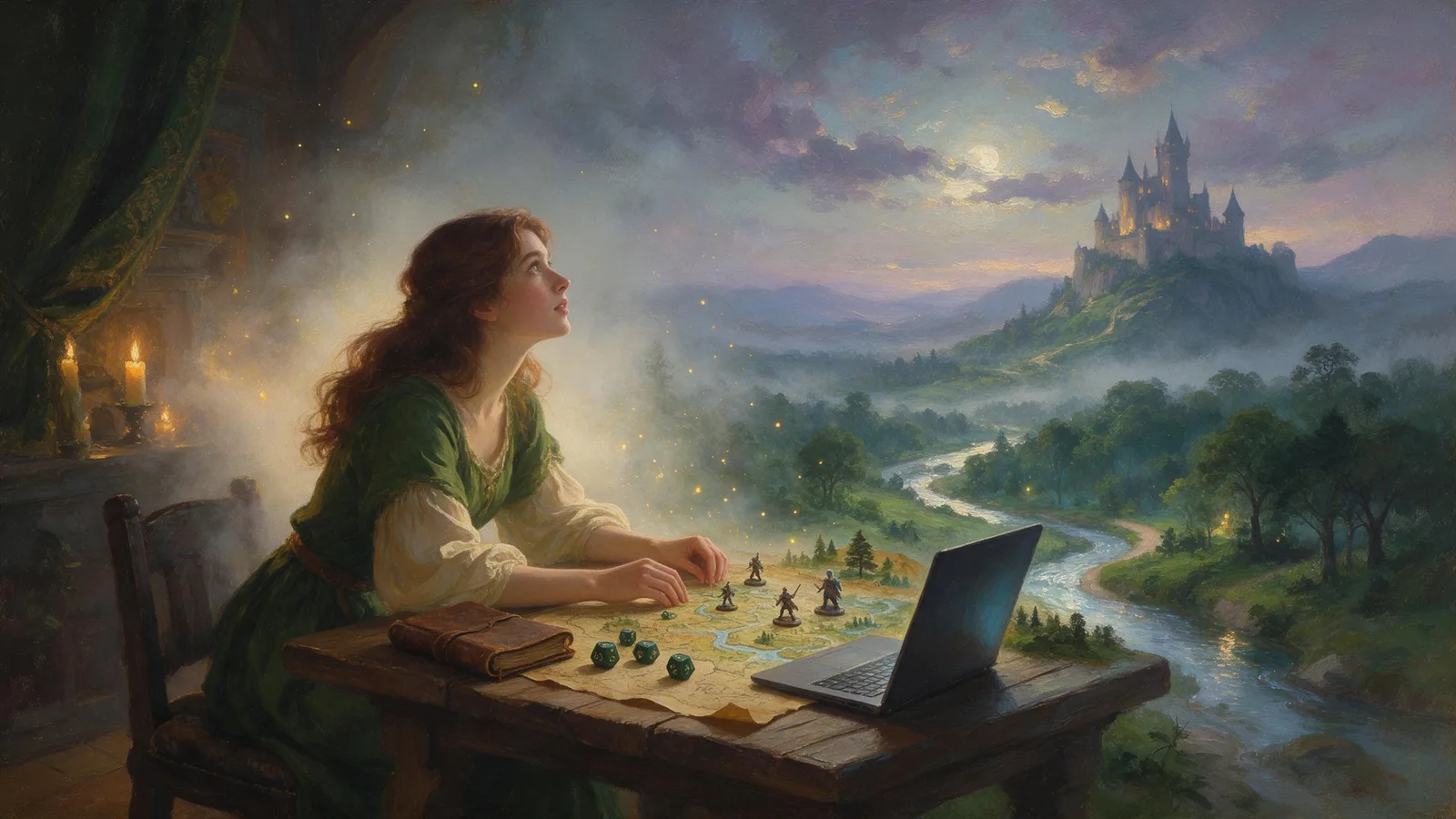
My first solo AI roleplay campaign started in a tavern. I was using a general-purpose AI chat tool, and I honestly didn’t know what I was doing.
I had my character, Friya, and a party of friends with different amounts of history between us. Then the AI introduced a woman who walked into the tavern looking for help. Her brother was missing. She didn’t have much gold to offer, but she could give us warm shelter in her village.
That was the moment I was hooked.
We helped find her brother and settled into a village that welcomed us for helping one of their own. That story continued for months. There were romances, betrayals, moments that made me laugh, and others that were gut-wrenchingly sad. The depth of the characters surprised me.
I still get chills thinking about how it ended. I’ll come back to that, because the ending says a lot about why I love this kind of play.
If you want to try a solo RPG with AI, you can begin just as simply: a character, a few companions if you want them, and an opportunity to do something.
What is a solo AI RPG?
A solo AI RPG is a roleplaying experience you play on your own, with AI helping portray characters, describe situations, and respond to your actions.
You control your character: what they say, what they attempt, and what matters to them. Depending on the tool, the AI might act as a narrator, portray individual NPCs, or work within a game that tracks parts of the world.
“Solo” means you’re the only human player. You can still adventure with an entire party of AI-portrayed companions, as I did with Friya.
Some players want dangerous encounters. Others want political intrigue, romance, everyday life, or an open world to explore. Your first step is deciding which experience sounds fun to you.
1. Choose the kind of experience you want
Before you build anything, finish this sentence:
“I want to play a story about a person who…”
For example:
…inherits a failing tavern in a town full of secrets.
…works as a courier between rival space colonies.
…joins a guild that has mistaken them for someone else.
…moves to a new city and tries to build a life.
This gives your game a direction without deciding the ending. You can also begin with less. My starting point was a party in a tavern; the missing-brother request gave us a reason to head out together.
Also choose a tone. A cozy village mystery and a brutal survival adventure could use the same map, but they need very different characters and situations. Establish any themes you want to avoid before you begin.
2. Choose a tool that fits how you want to play
If you have access to ChatGPT, Claude, Grok, or a similar AI chat tool, you already have a place to start a solo AI RPG campaign. Describe your character, set the scene, and ask the AI to portray the world and the people you meet. You don’t need a dedicated RPG platform to give it a try.
I started in a general-purpose AI chat tool myself. That’s where Friya’s campaign happened, and it was enough to get me invested in a story that lasted months.
If you enjoy inventing scenes through conversation, a flexible AI chat experience may be enough. If locations, inventory, relationships, and continuity matter to you, look for a game that explicitly supports those things.
Useful questions to ask include:
Can I create my own setting and characters?
How does it preserve important events?
Can multiple characters participate in the story?
Does it track locations, time, or inventory?
How much setup do I want to do before playing?
If you want a more visual, grounded worldbuilding experience, that’s what we built RPBuddy for. You can build a world on a map, populate it with characters, and play within systems that track elements such as location, time, relationships, and inventory. We purpose-built it to help recreate the same magic I felt in Friya’s story, with a world you can see and shape around those interactions.
Whichever tool you choose, start with a small scenario so you can learn how it works through play.
3. Create your character and a few connections
You don’t need a ten-page biography. Start with who your character is, something they care about, and a connection that gives you something to work with.
Friya began with a band of friends, and we had varying levels of history together. That gave the party relationships to explore from the start.
If you want to start with companions, ask yourself:
Who does my character already trust?
Who is still getting to know them?
Is there an old disagreement or shared experience between them?
What gives this group a reason to stay together?
Leave room to discover the answers through play. The characters introduced throughout my campaign developed a depth I hadn’t expected, and their relationships became a huge part of why I kept returning.
You can also begin alone and meet your companions along the way.
4. Start with one small location
A whole continent can wait. A tavern was enough for my first scene, and the village we helped became somewhere we wanted to stay.
For your own opening, establish:
A place to begin: A tavern, a roadside camp, a busy market, or a spaceport.
Someone to interact with: A traveler, a neighbor, an old friend, or a person asking for help.
An unresolved situation: Someone is missing, a delivery hasn’t arrived, or an unexpected visitor has appeared.
You can build outward as you play. Let an errand introduce a nearby settlement. Let a conversation give you a reason to visit a new part of town.
In my campaign, helping someone gave us a connection to a place. By the end, that same village was home.
5. Begin at a moment that demands a choice
Give yourself an opportunity to respond to something. You don’t need to invent the entire adventure yourself.
The woman who entered our tavern had a straightforward request and very little to pay us with. It was enough to make us want to help. We had a reason to leave the tavern and see what happened next.
If you’re starting in a general-purpose AI chat tool, here’s a sample prompt you can adapt:
I want to play a solo fantasy RPG. I’ll control my character, and you’ll portray the world and the other characters. My character is traveling with a small party of friends, some of whom know each other better than others. Begin in a tavern and introduce someone with a problem we might choose to help with. Leave my character’s actions and dialogue to me, and pause so I can respond.
Add your character’s name and whatever background you’ve decided on. In a dedicated RPG tool, use its character and world setup options to establish a similar starting situation.
During play, describe what your character attempts and let the response establish what happens next. You can ask questions, investigate, negotiate, take risks, or walk away.
6. Keep important events consistent
Continuity matters most when earlier choices affect later scenes.
After a significant event, check that the details you care about are preserved using your tool’s available notes, memory, or world information features.
Focus on:
Promises your character made.
Changes in relationships.
Clues you discovered.
Unresolved goals.
Who witnessed or learned about an event.
That last point is particularly useful. A secret told privately to the innkeeper should have a believable route to reach the guard captain.
If something becomes inconsistent, correct it briefly and continue. Clear, specific corrections are easier to work with than rewriting your entire backstory.
7. Let your choices change the story
You don’t need to plan a perfect campaign before playing. My story lasted months, and the relationships became as memorable as the adventure itself. Romances developed. Betrayals happened. There were happy, funny, and deeply sad moments along the way.
I also used time skips to explore how the characters grew over time. You don’t have to play every day of their lives to see them change.
When a chapter feels complete, you might move forward a few weeks or years. Before doing that, establish what your character intends to do during that time and which important decisions you want to keep control over. Then explore what has changed.
For your first session, though, keep the goal small: meet someone, discover something, and make one decision that matters.
The ending I still think about
I ended Friya’s campaign after the main arc concluded. In the final fight, the party member who had become our father figure died. His death became the catalyst for the rest of us to defeat the great evil we were facing. We succeeded, but we had lost him.
We brought his body home to the same village that had welcomed us at the beginning. There, we made a monument from his hammer to honor him.
Then I asked the AI for a time skip of ten years.
What followed felt cinematic. It described his hammer, still shiny on its pedestal, then the image fading into the same hammer worn by time and covered in lush greenery. The view pulled back to reveal the village, which had grown a hundredfold over those years.
Characters we knew had families. The younger ones were grown up. We could see the lives that continued after that final fight.
It was beautiful, and it made me emotional. Months earlier, we’d been a party in a tavern agreeing to help someone find her brother. Now we were looking at the future of the place that had become our home.
That’s what stayed with me: the people, the shared history, and seeing what became of them.
Start your first adventure
Choose a character, a place to begin, and someone to interact with. Give yourself room to be surprised by what happens next.
Open the AI chat tool you already use and try the starting prompt above. If you’d like a more visual world to build and explore, try RPBuddy. That feeling of growing attached to a place and the people in it is exactly what we built it to help you find.
Mine started in a tavern, with a woman asking for help. That was enough.